
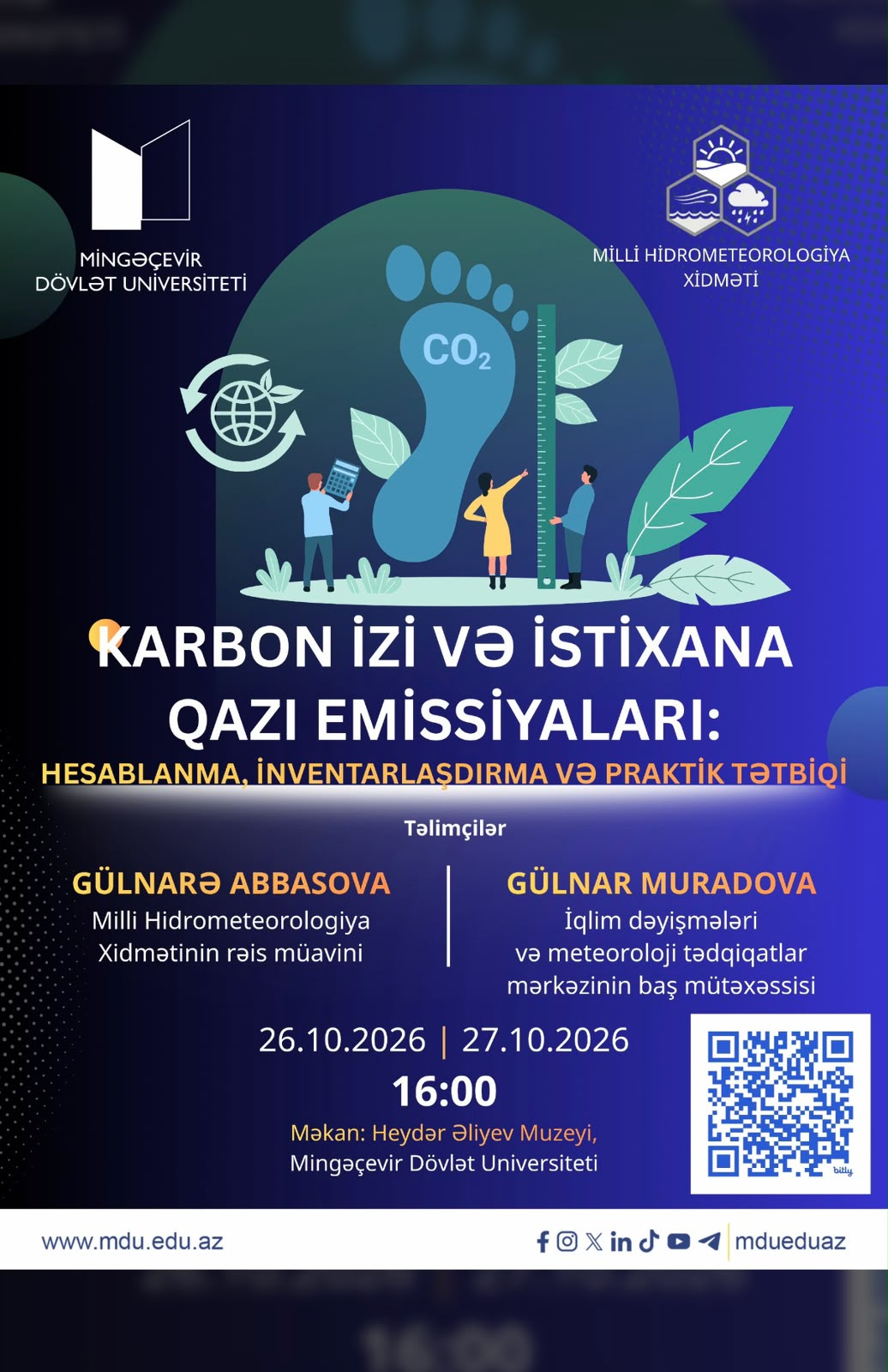
On October 26–27, 2026, a training session titled “Carbon Footprint and Greenhouse Gas Emissions: Calculation, Inventory and Practical Application” will be held at the Heydar Aliyev Museum of Mingachevir State University (MDU).
The training will be attended by MDU’s academic staff, employees, master’s students and undergraduate students. It aims to expand participants’ knowledge of carbon footprints and greenhouse gas emissions, introduce them to methods for calculating and inventorying emissions, and discuss practical approaches to reducing them.
The trainers will be Gunara Abbasova, Deputy Head of the National Hydrometeorology Service, and Gunel Muradova, Chief Specialist at the Center for Climate Change and Meteorological Research.
The training will cover the following topics:
- Carbon footprint and its calculation methodology
- Identification and calculation of greenhouse gas emissions
- Emissions inventory and reporting of results
- Assessment and reduction of carbon emissions
- International experience in addressing climate change
The training will highlight the importance of accurately calculating and systematically recording emissions indicators to assess climate impacts and plan appropriate measures.
The event is being organized within the framework of the cooperation memorandum between MDU and the National Hydrometeorology Service under the Ministry of Ecology and Natural Resources of the Republic of Azerbaijan. The memorandum was signed on July 13, 2026, by MDU Rector Anar Eminov and Head of the National Hydrometeorology Service Nazim Mahmudov.
The memorandum provides for expanded cooperation in meteorology, climate change and climate services; student placements; the involvement of specialists in the teaching process; and the organization of seminars and training sessions. The parties are also cooperating in the digital processing of meteorological data, research and practical projects, and the training of highly qualified specialists.
The training is expected to contribute to strengthening students’ and employees’ knowledge of climate and environmental issues and to linking this knowledge with teaching and research. The initiative will support ongoing efforts to promote environmental responsibility, develop a sustainable campus environment and apply academic knowledge to addressing issues relevant to the region.