
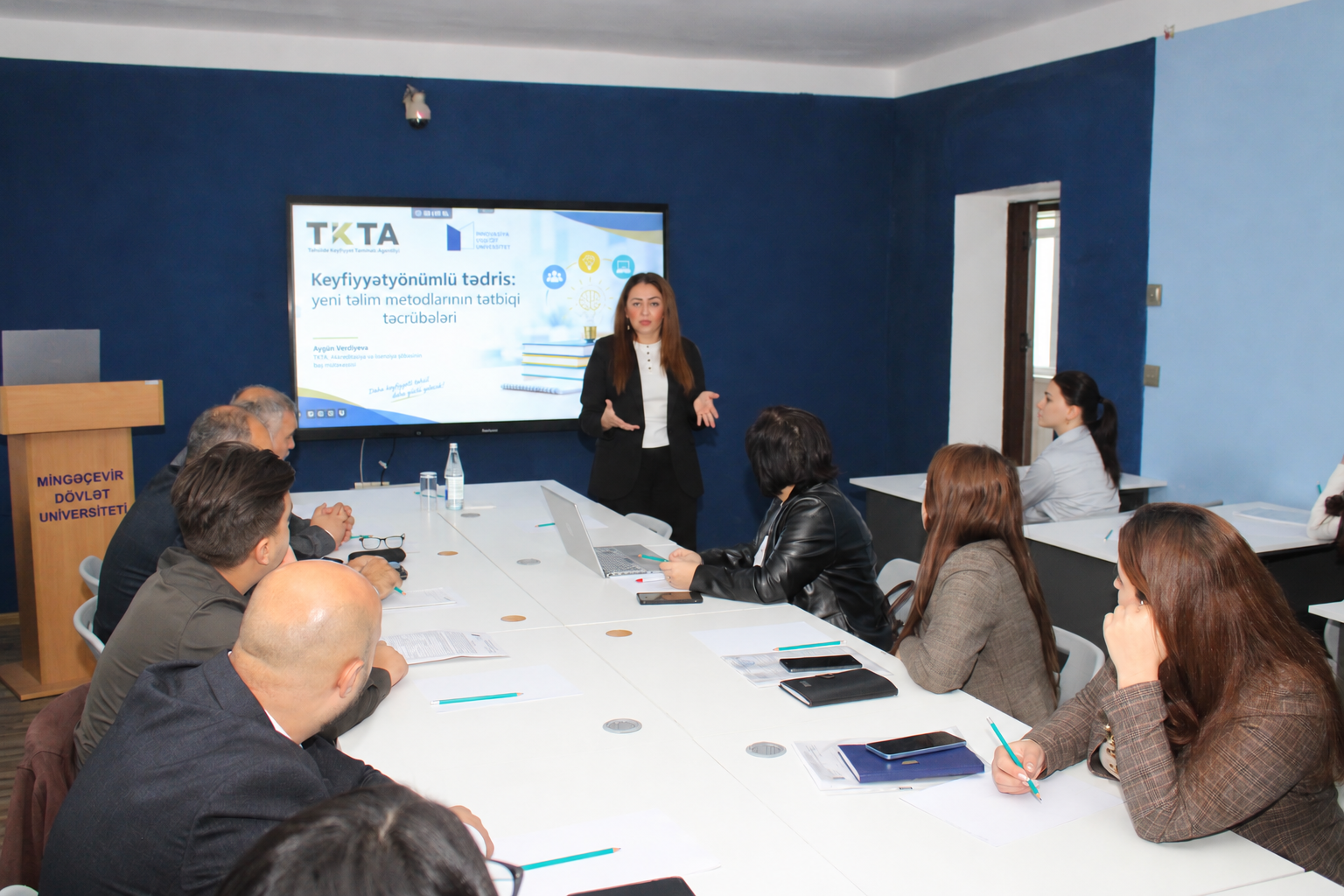
On October 29–30, 2026, two training modules dedicated to quality assurance, innovative teaching methods, and student-centered educational approaches were organized for the academic staff of Mingachevir State University (MDU), jointly by the Education Quality Assurance Agency (TKTA) and MDU.
The main purpose of the training sessions was to develop the professional competencies of academic staff, integrate modern pedagogical approaches and innovative teaching methods into the educational process, and support the creation of an inclusive, accessible, and high-quality learning environment that takes into account students’ individual learning needs.
During the two-day training sessions, Aygun Verdiyeva, Chief Specialist of the Accreditation and Licensing Department of the Education Quality Assurance Agency (TKTA), served as the trainer on the topic “Quality-Oriented Teaching: Experiences in Implementing New Teaching Methods.”
The training focused on the fundamental principles of quality assurance in higher education, the application of modern teaching methods, the effective achievement of learning outcomes, and the continuous improvement of academic activities. Aygun Verdiyeva emphasized the importance of innovative pedagogical approaches, interactive methods, and outcome-oriented teaching strategies in enhancing the quality of education. She also highlighted that the professional development of academic staff and the integration of best practices into the teaching process contribute to strengthening the culture of quality within the university.
The training session entitled “Establishing a Student-Centered Education Culture: Teaching, Learning, and Assessment” was conducted by Gunay Mammadova, Senior Advisor at TKTA. The session addressed the fundamental principles of student-centered education, consideration of individual learning needs, increasing student engagement in the educational process, and modern assessment approaches.
Gunay Mammadova discussed the importance of enabling students to become active participants in the educational process and developing their critical and creative thinking, independent learning, problem-solving, and collaboration skills. She also emphasized that the implementation of transparent and objective assessment mechanisms, the provision of constructive feedback, and the creation of equal learning opportunities are essential conditions for quality higher education.
Both modules were organized in an interactive format. Participants engaged in discussions on the presented topics, examined practical examples, and evaluated opportunities to apply the knowledge gained to the teaching process through mutual exchange of experience.
The training sessions were significant in terms of supporting the continuous professional development of academic staff, promoting innovative approaches in education, strengthening inclusiveness and equal opportunities, and improving institutional quality assurance mechanisms. In addition, they provided opportunities to explore the application of modern teaching methods, the efficient use of digital and interactive learning opportunities, responsible management of educational resources, and the development of a culture of lifelong learning.
It should be noted that continuously improving the quality of education, strengthening the pedagogical and professional competencies of academic staff, increasing student satisfaction, and developing an inclusive and student-centered higher education environment aligned with modern standards are among the key strategic priorities of Mingachevir State University. Relevant activities in these areas are expected to continue.