
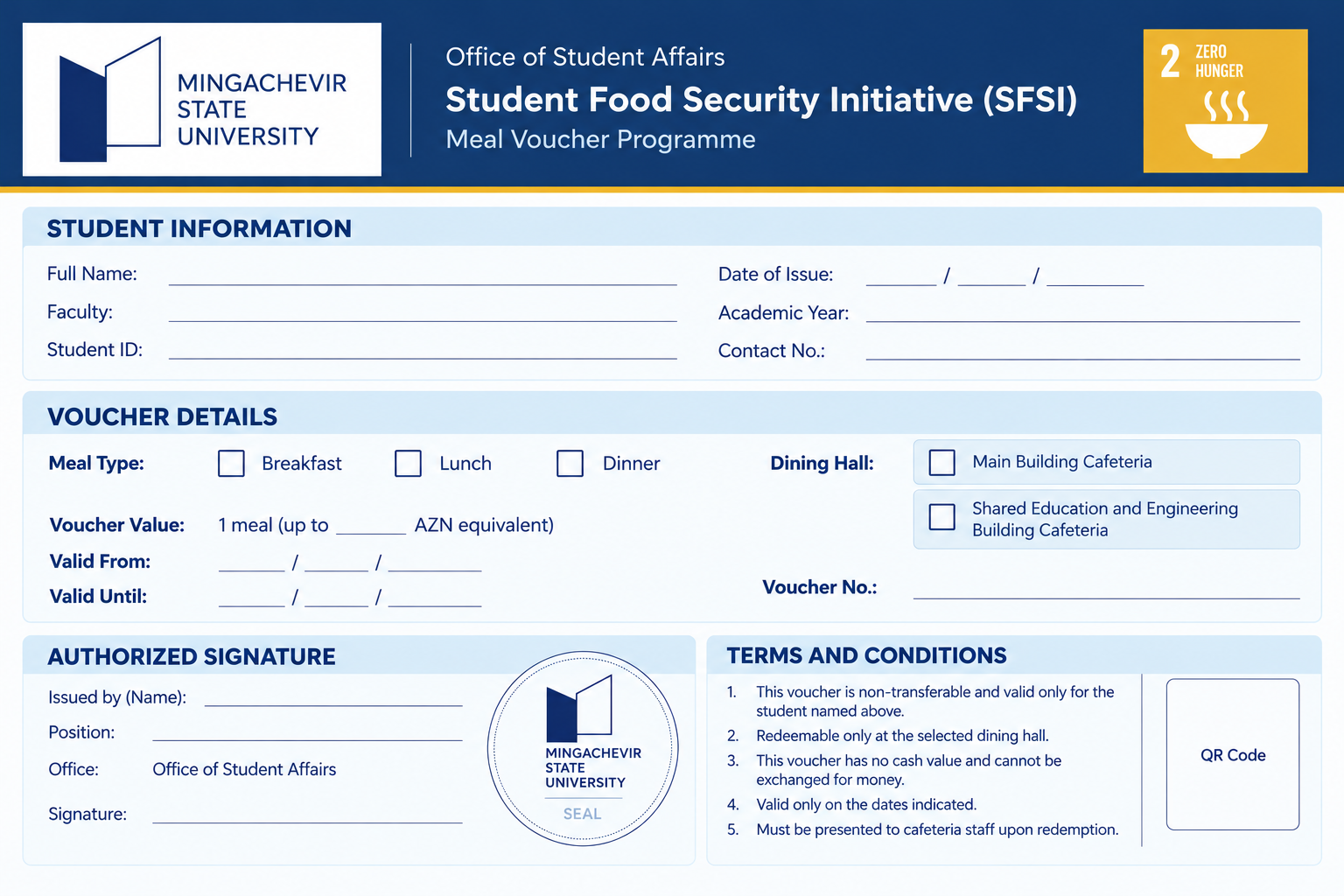
Mingachevir State University (MSU) implements the Student Food Security Initiative (SFSI) to strengthen student welfare and improve access to food. The programme aims to address students’ food needs, reduce financial difficulties associated with meal expenses, and foster a more inclusive university environment.
Food Support Through Meal Vouchers
One of the main components of the programme is providing students with support through meal vouchers. This mechanism offers financial assistance to students to obtain meals at designated university cafeterias.
According to the programme data for the 2025–2026 academic year, 950 students received meal vouchers, each valued at AZN 10. The total financial value of the support provided through 950 vouchers amounted to AZN 9,500.
The meal vouchers help reduce students’ meal expenses and support their access to food. To ensure transparency and proper record-keeping, the vouchers are designed to include relevant information, such as student details, the validity period, the selected cafeteria, and other applicable information.
Assessment of Student Needs and Programme Improvement
At MSU, assessing students’ food accessibility needs and monitoring the outcomes of the support provided are important for the continued development of the programme. Information on voucher utilisation, student feedback, and the accessibility of food services provides a basis for improving existing support mechanisms.
This approach aims to strengthen student welfare and reduce the potential negative impact of food-related difficulties on students’ educational experience.
Contribution to the Sustainable Development Goals
Supporting students’ access to food is directly aligned with United Nations Sustainable Development Goal 2 (SDG 2): Zero Hunger. The programme also contributes to SDG 3: Good Health and Well-being and SDG 4: Quality Education by supporting students’ well-being and helping create conditions conducive to learning.
Mingachevir State University considers the development of support mechanisms that address students’ social needs, improve food accessibility, and assess institutional activities through measurable outcomes to be a priority.