
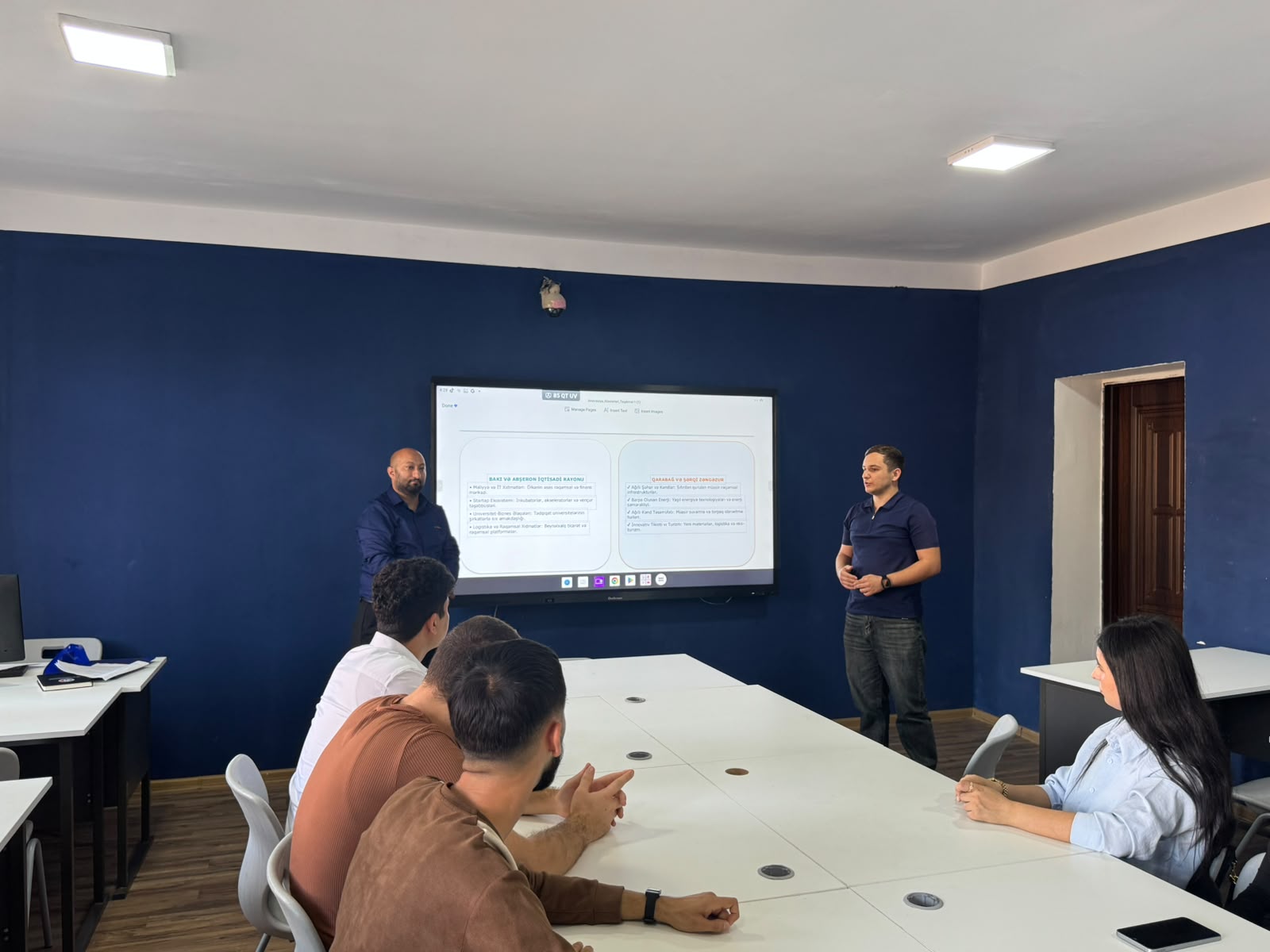


On October 13, 2026, a roundtable on “Innovation clusters and regional economic competitiveness” was organized by Eshgin Ismayilov, a lecturer at the Department of Economics of Mingachevir State University.
The main objective of the event was to discuss the role of innovation clusters in regional economic development, the economic significance of innovative cooperation models, and opportunities to enhance regional competitiveness. During the roundtable, it was emphasized that innovation clusters play an important role in strengthening cooperation among enterprises, universities, research institutes, and government institutions, integrating knowledge and technologies into economic activities, and supporting innovative initiatives.
The discussions focused on the mechanisms for establishing innovation clusters, knowledge and technology transfer, production cooperation, the development of innovative entrepreneurship, and increasing investment attractiveness. It was noted that establishing effective cooperation among economic entities can create favorable conditions for expanding production capacity, using existing resources more efficiently, and introducing new technologies.
The roundtable also examined the potential impact of clustering on optimizing production costs, increasing labor productivity, creating new jobs, and diversifying regional economies. It was noted that the efficient use of regional economic potential, the expansion of innovation opportunities for local enterprises, and the development of new areas of economic activity are important factors in strengthening regional resilience.
The discussions highlighted the importance of government support mechanisms, modern infrastructure, human capital, and the efficient use of research potential in developing regional innovation ecosystems. It was emphasized that strengthening links among universities, businesses, and research institutions can contribute to the practical application of scientific knowledge, the commercialization of innovative ideas, and the knowledge-based development of the economy.
The event also focused on the opportunities offered by innovation clusters in terms of digital transformation, the adoption of technological innovations, and adaptation to contemporary economic challenges. In this context, the role of interaction among digital technologies, research and innovation activities, and entrepreneurial initiatives in enhancing the adaptability and competitive advantages of regional economies was highlighted.
The roundtable was significant in fostering analytical thinking on regional economic development, strengthening the ability to assess economic processes, and promoting innovation-oriented approaches. The discussion of the topic from various perspectives contributed to a deeper understanding of the importance of innovation clusters in expanding economic cooperation, promoting knowledge exchange, and realizing the development potential of regions.
Scientific and awareness-raising initiatives implemented by Mingachevir State University in this field contribute to fostering an innovation culture, highlighting the importance of university-industry collaboration, and exploring contemporary trends in regional economic development. This approach is particularly important for connecting economic knowledge with practical challenges, fostering innovative thinking, and preparing professionals who can contribute to the long-term and competitive development of regions.