
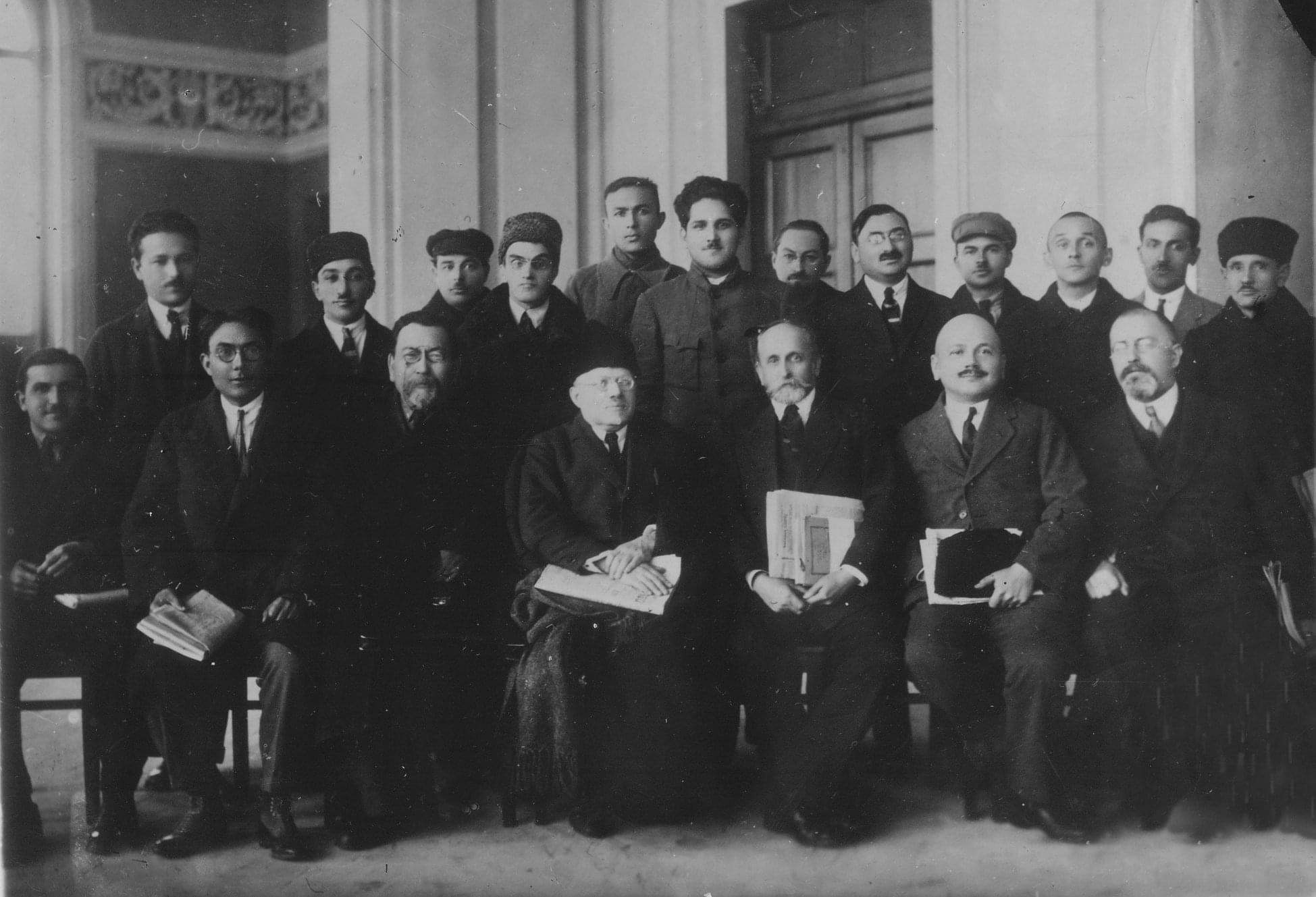
Sometimes there are books that are not merely made up of pages and ink, but are a cry rising from the dusty shelves of history. Professor Nadir Mammadli’s work “The First Turkological Congress of 1926: in Historical Context, Archival Documents and the National Press” is precisely such a book. The author presents to us not only archival documents, but also a chronicle of the revival and hopes of a nation.
Where does the spirit of this book lie?
First of all, it lies in the author’s language and style. In the book, the precision of academic style is combined with the fire of journalism. The author does not merely narrate events; behind every transcript and every confidential document, he reveals human destinies, emotions and real life, making them engaging and vivid for the reader. This approach requires great mastery and love for the art of writing. The language of the book whispers to us that even the “ands”, “buts” and “howevers” of those years were the result of great struggles. The syntactic analysis of archival documents shows that the scholars of that period were not only changing the alphabet; they were laying the foundation for a new way of thinking. By passing these documents through the filter of modern language, the author takes them out of the “dusty memory” of the past and turns them into the “bright light” of the future. Building a spiritual bridge between yesterday and today, the researcher proves through his style that truth sooner or later emerges from the archives and begins to speak in its native language. In the words of the linguist himself: “The work was written to understand the breath of those days, the trembling of the voices in that hall, and the historical weight hidden behind every idea expressed from the rostrum.”
The sounds, words and sentences in the book harmonize with one another, creating a beautiful rhythm. What affects the reader is the spirit carried within this harmony — a spirit that could be realized through speech capable of absorbing it. The scholar standing guard over national memory has united the voice coming from within with the mission placed before him by history, worked for the future, and the language, manner of expression and style of the writer have emerged precisely from this point, from this demand. This book is, as it were, the fulfillment of a moral duty. Most of the words that give the language of the book familiarity and naturalness come from the national memory of the people. In this book, language is presented not merely as a means of communication, but as a carrier of national spirit, spiritual memory and aesthetic thought. The sincerity of the writings creates inner peace and spiritual warmth in the reader. The special importance given in the style of the work to the cultural integration of Turkic peoples and the preservation of national identity shows that the author approaches this historical event with national devotion.
Let us pay attention to the following sentences from the book:
“This congress was not simply a gathering of scholars. It was an arena where alphabets, languages and cultures carrying the burden of centuries confronted one another. The Arabic script, which had carried the memory of the Turks for millennia, and the Latin alphabet, presented as the bright tomorrow of the new world, faced each other here for the first time. Behind these contradictions stood not only writing, but also the fate of Turkic-speaking peoples. There was a light in people’s eyes. At that moment, the hearts of the crowd in the street and those sitting in the hall beat as one. The stone walls of the Ismailiyya building have preserved the harmony of that voice for a hundred years as witnesses to that day engraved in the memory of history!”
In the work, not only archival documents but also the place where the event took place is brought to life. The walls of the Ismailiyya building are presented not merely as an architectural object, but as living witnesses of history. In the author’s description, the walls of the building seem to have absorbed the excitement and tension of that period and now whisper those events to us. This artistic approach shows that history lives not only in books, but also in the stones and walls where the moment took place, thereby beautifully revealing the symbolic significance of the place.
“That day, Baku was not simply a capital city — it was the heart of the Turkic world, a testing ground for its cultural and political future. Every speech, every protocol, every dispute — what now appears to us as ‘words’ on archival papers — was then either hope, fear or great faith in the souls of people. A history was being written within the walls of the Ismailiyya building, sheltered by Sabir Garden — the power of the word would change the destiny and future of an entire Turkic world!”
Here, archival documents are approached not only as scholarly facts, but almost as living organisms, and metaphorical transfer is used. Before our eyes, the “silent” and “cold” papers in the archives turn into the living human feelings of that period — hope, fear and faith.
Speaking from the position of a citizen-intellectual, Professor N. Mammadli presents the beginning and ending dates of the congress not merely as calendar numbers, but as a symbolic contrast in nature. By juxtaposing “the harsh breath of winter” with “the arrival of spring”, he interprets this scholarly event as a transition from the old to the new, from darkness to light. The logical contrast established here between natural phenomena and the fate of the nation proves that the congress was not simply a meeting, but a door opening from the spiritual winter of the Turkic world to its cultural spring. The author describes this historical turning point as follows:
“26 February 1926 — at a time when the harsh breath of winter wandered through the streets, when pure, clear, sunny weather and darkness merged into one another, at 7 o’clock in the evening the bright lights burning in the Ismailiyya building illuminated the night of Baku. On 6 March, when the breath of spring filled the city, the congress too had spoken its word and entered history. This path stretching from the darkness of winter to the light of spring was a trail opened toward the future of the Turkic world. It was as if nature itself had created the symbol of this assembly: from winter to spring, from the old to the new!”
In the first chapter, entitled “The First Turkological Congress: in Historical Context”, N. Mammadli, the chronicler of our national destiny, does not limit himself to presenting the original versions of the congress reports. Through his interesting and emotional comments on each speech, he brings the reader directly into the tense scholarly and political atmosphere of 1926. Here, academic precision and journalistic clarity complement each other, making the essence of events more vivid.
Looking at Ashmarin’s studies through this prism, the author notes: “Ashmarin’s research into the roots and semasiology of Turkic words is a vast field that no one has touched, and it promises rich results for science. Every word of a language, in its original meaning, is an echo of primitive thought, a memory of ancient customs, a fragment of a forgotten way of life, the trace of an old melody, a sign of an ancient worldview, a mark of the understanding of nature.”
When interpreting Ashmarin’s speech, the author synthesizes scientific terminology and artistic description with such mastery that the reader clearly feels, in every layer of language and its semasiology, the traces of the Turk’s forgotten way of life and ancient perception of nature. The author also skillfully embeds quotations and transcripts given in the words of historical figures into his modern commentary without causing any stylistic rupture. He writes: “Chobanzade deliberately showed that the reason for the separation of languages was not so much an ethnic foundation as geographical, political and cultural processes.” This is syntactic integration. The author connects the language of the past — the archival quotation — to today’s scholarly reasoning, thereby cleansing the images of personalities from archival dust and elevating them to the level of “living interlocutors”.
To make the reader feel the tension and spirit of the period, the author writes the course of the congress with dynamic narration and inner energy. The following lines, which summarize the speeches of the congress participants and the historical significance of that moment, are the clearest example of this dynamism:
“Every sentence, every speech, every proposal was both a scientific and political manifesto. Applause mixed with voices, sharp objections and tense moments created an atmosphere of intensity. In fact, this congress was a bridge: from the alphabet of the past to the alphabet of the future, from national memory to cultural modernization! The speeches delivered at the congress and every slogan raised from the rostrum were calls addressed to the future, tuned to the spirit of the Turkic world.”
In the second chapter of the book, entitled “The First Turkological Congress in Archival Documents”, the author skillfully interprets the political weight and ideological essence of archival documents against the background of secret documents and transcripts revealed for the first time. The author does not confine himself to the analysis of linguistic facts; he examines the issue on a broader geopolitical plane and arrives at the following political conclusion:
“The document once again confirms that the 1926 Baku Turkological Congress, while being a scientific forum, was also an important political instrument of the Soviet state’s national policy. Every step of it was transmitted to Moscow in the form of reports, while the central party bodies adapted the results of the congress to their ideological line. The initiatives of the Azerbaijani representatives gained legitimacy only on the basis of documents submitted to and approved by Moscow. This also proves that the Soviets kept cultural and language policy in the national republics under direct control. This step was not merely an academic initiative; it aimed to centralize and control the cultural development of Turkic peoples within the USSR.”
In the example presented, the author uses a synthesis of scientific-analytical and political-journalistic styles, approaching events from a critical-historical, deconstructive perspective. He investigates the internal logic of facts and cause-and-effect relationships, demonstrating a clear position toward events. Thus, he exposes the strategic-political mechanisms hidden behind the academic veil of the congress and gives a final assessment of the event not only as a linguist, but also as a professional political commentator restoring the ideological landscape of history.
The academic precision characteristic of Professor N. Mammadli’s style is clearly manifested in rich sentence structures composed of homogeneous elements. The author examines every event he studies not from one side only, but through a systematic analytical filter that simultaneously covers all its layers — its ideology, mechanism of implementation and consequences. This broad perspective and information-dense language find their most perfect expression in many sentences of the work, including the third chapter, entitled “The First Turkological Congress in the National Press”:
“The text is an important journalistic source reflecting the ideological foundations of the alphabet reform carried out in Turkey in the late 1920s, the mechanism of its public acceptance and the effects it produced in the context of the Turkic world.”
There are rich word combinations formed around the word “ideological” in the work. For example: ideological fragmentation, ideological purpose, ideological directives, ideological control, ideological meeting, ideological foundations, ideological conformity, ideological essence. By using this word in different contexts, the author expands its semantic boundaries and visualizes the socio-political atmosphere of the period.
The work “The First Turkological Congress of 1926: in Historical Context, Archival Documents and the National Press” is a spiritual monument erected to our intellectuals who were oppressed under the heavy pressures and harsh prohibitions of those years, yet did not abandon their convictions. Our esteemed intellectual Nadir Mammadli, with the sensitivity of a scholar who knows the possibilities of the word, reveals the human destiny behind every document and the hidden pain in every line. The unquenchable civic passion and unshakable national devotion in the author’s heart shed light on the dark pages of our history. This research is not merely an account of the past; it is a lesson in memory that reconnects us with our roots, purifies us before the spirit of our ancestors, and is passed on to the future as a sacred trust.
Könül Aydın
Lecturer at the Department of Humanities, Honored Teacher,
Doctoral student of the Department of Turkic Languages,
Institute of Linguistics named after I. Nasimi, ANAS